Showing posts with label nuclear. Show all posts

Friday, March 25, 2011

Comparing deaths from energy production

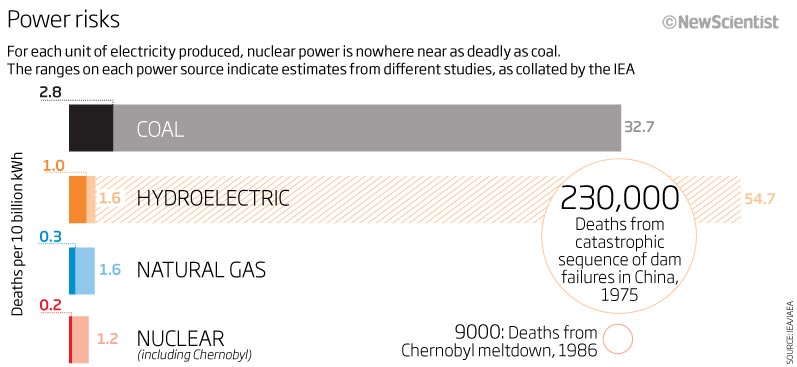
This diagram from a NewScientist article shows how fossil fuels are far deadlier than nuclear.

A blogger has also compiled the following list which also includes renewable energy.

Energy Source - Death Rate (deaths per TWh)

Coal – world average - 161 (26% of world energy, 50% of electricity)
Coal – China - 278
Coal – USA - 15
Oil - 36 (36% of world energy)
Natural Gas - 4 (21% of world energy)
Biofuel/Biomass - 12
Peat - 12
Solar (rooftop) - 0.44 (less than 0.1% of world energy)
Wind - 0.15 (less than 1% of world energy)
Hydro - 0.10 (europe death rate, 2.2% of world energy)
Hydro - world including Banqiao) - 1.4 (about 2500 TWh/yr and 171,000 Banqiao dead)
Nuclear - 0.04 (5.9% of world energy)

Thursday, March 17, 2011

Graphs of radiation levels in Japan

The graphs give the radiation level in µSv/hour. According to wiki the natural background radiation is 2.4 mSv/year, which is 0.27 µSv/hour.

It doesn't look too bad yet. See the rest of the graphs here.

A graph of radiation risks for comparison:

Tuesday, June 15, 2010

Nuclear power plant wall test

We've already seen that nuclear casks used in transport are virtually indestructible. Good nuclear power plants are also safe.

Better quality extended version of only the crash from different angles here.

Wednesday, May 05, 2010

Nuke that Slick

"As BP prepares to lower a four-story, 70-ton dome over the oil gusher under the Gulf of Mexico, the Russians — the world’s biggest oil producers — have some advice for their American counterparts: nuke it.

Komsomoloskaya Pravda, the best-selling Russian daily, reports that in Soviet times such leaks were plugged with controlled nuclear blasts underground. The idea is simple, KP writes: “the underground explosion moves the rock, presses on it, and, in essence, squeezes the well’s channel.”

Yes! It’s so simple, in fact, that the Soviet Union, a major oil exporter, used this method five times to deal with petrocalamities. The first happened in Uzbekistan, on September 30, 1966 with a blast 1.5 times the strength of the Hiroshima bomb and at a depth of 1.5 kilometers. KP also notes that subterranean nuclear blasts were used as much as 169 times in the Soviet Union to accomplish fairly mundane tasks like creating underground storage spaces for gas or building canals."
I'm sure Greenpeace does not approve and, as usual, prefers to scrub ducks over real solutions.

Wednesday, April 28, 2010

Germany's First Offshore Wind Farm

These things are huge with a rotor diameter of 126 m and a hub height of 92 m. The project cost €250 million and delivers 60MW. This sounds really expensive and results in a capital cost of €4167/kW, but surprisingly this doesn't compare too badly to some recent nuclear projects estimated between $3376/kW to $8071/kW. However China is currently planning it's future nuclear plants will produce at $1000/kW which is very favorable. These are only capital cost and I don't know how much the upkeep of offshore windmills or nuclear costs. And of course this doesn't factor in the intermittent power produced by wind, which would need expensive storage systems to be able to provide base-load power. At least they are impressive to look at. On the factor of safety windmills aren't as benign as is sometimes assumed, resulting in 66 worker fatalities since the 70s. Other fun things that can happen to windmills are: 172 instances of blade failure Pieces of blade are documented as travelling up to 1300 meters. In Germany, blade pieces have gone through the roofs and walls of nearby buildings. (Video) 139 fire incidents 84 instances of structural failure 30 incidents of ice throw, travelling up to 140m

Saturday, April 17, 2010

Age Determination and Art Forgery Detection using Nuclear Tests


"The above-ground nuclear tests that occurred in several countries between 1955 and 1980 (see nuclear test list) dramatically increased the amount of carbon-14 in the atmosphere and subsequently in the biosphere; after the tests ended the atmospheric concentration of the isotope began to decrease.
One side effect of the change in atmospheric carbon-14 is that this enables the determination of the birth year of an individual: the amount of carbon-14 in tooth enamel is measured with accelerator mass spectrometry and compared to records of past atmospheric carbon-14 concentrations. Since teeth are formed at a specific age and do not exchange carbon thereafter, this method allows age to be determined to within 1.6 years. This method only works for individuals born after 1943,[11][12] and it must be known whether the individual was living in the Northern or the Southern Hemisphere at the age when the tooth would have formed." - wiki
"Synthetic elements, such as einsteinium and fermium, created by neutron bombardment of uranium and plutonium during thermonuclear explosions, were discovered in the aftermath of the first thermonuclear bomb test. In 2008 the worldwide presence of new isotopes from atmospheric testing beginning in the 1950s was developed into a reliable way of detecting art forgeries, as all paintings created after that period may contain traces of cesium-137 and strontium-90, isotopes that did not exist in nature before 1945." - wiki

Thursday, March 18, 2010

Nuke it

Someone made a little program that show the effects of various nuclear bombs, ranging from the Hiroshima bomb to the Tsar Bomba, on a place of your choice. The picture below shows the heat damage a Hiroshima sized bomb would cause if dropped on Utrecht. You can play with it here. Click on the marker to see what the colors mean.

Wednesday, July 22, 2009

A Rational Environmentalist!

From TED: Stewart Brand proclaims 4 environmental 'heresies' The man who helped usher in the environmental movement in the 1960s and '70s has been rethinking his positions on cities, nuclear power, genetic modification and geo-engineering.

Tuesday, May 26, 2009

Nevada Test Site

This is the area where the US did a lot of nuclear detonation tests. Notice the biggest crater at the top. That's Sedan Crater, and at 390m it is the largest man-made crater in the United States. It was created to study the use of nuclear weapons for mining and cratering. It released the most radioactive fallout of any test in the US. This is the explosion that made it:

Tuesday, February 10, 2009

U.N. Acquires Nuclear Weapon

NEW YORK—The United Nations, a highly organized governing body bent on world peace, has obtained a nuclear warhead and intends to use the dangerous device to pursue its radical human rights agenda, sources reported Monday.

"I will say this as clearly as I can, so you all can hear me," said Ban, his finger hovering inches away from the small red button on his podium. "Either attend the next Follow-up International Conference on Financing for Development to Review the Implementation of the Monterrey Consensus, or prepare to suffer the consequences."

source: The Onion

Wednesday, January 28, 2009

99% Nuclear Waste Destruction

U of T at Austin scientists propose destroying nuclear waste from other nuclear fission reactors using a fusion-fission hybrid reactor, the centerpiece of which is a high power Compact Fusion Neutron Source (CFNS) made possible by a crucial invention, the Super X Divertor. The CFNS would provide abundant neutrons through fusion to a surrounding fission blanket that uses transuranic waste as nuclear fuel. The fusion-produced neutrons augment the fission reaction, imparting efficiency and stability to the waste incineration process. One hybrid would be needed to destroy the waste produced by 10 to 15 LWRs (light water reactors). So Seven or eleven hybrids would be needed to match up with the existing 104 nuclear reactors in the United States. Thirty to forty-five would be needed to match up with the worlds existing nuclear fission reactors. The process would ultimately reduce the transuranic waste from the original fission reactors by up to 99 percent. More...
Via Next Big Future, a very interesting blog following technological development. If this works there is one less reason for those environMentalists to whine about nuclear energy.

Saturday, December 27, 2008

Testing the Safety of Nuclear Casks

Nothing to worry about.

Wednesday, December 17, 2008

Nukes in Space - The Rainbow Bombs

Media: Documentary
Name: Nukes in Space - The Rainbow Bombs IMDb / review: IMDb Runtime: 53 min Torrent Buy it @ Amazon

Why bother: V2, cold war, space race, exploding rockets, nukes in space, van Allen belts, ICBM's and stuff like that. It's more about rockets than nukes so the title may be a bit misleading. Rating: 8/10 - Rocketry is cool.

Monday, November 10, 2008

Miniature Nuclear Reactors to be on Sale Within 5 Years

Using technology licensed from the U.S. government, an Arizona-based company is planning to bring a new generation of miniature nuclear reactors to market. The Hyperion Hydride Reactor is not much larger than a hot tub, is totally sealed and self-operating, has no moving parts and, beyond refueling, requires no maintenance of any sort. The reactor will output 27MW, enough to power a community of 20,000 homes, says Hyperion Energy, makers of the new reactor. The first models will roll off the assembly line in five years. Unlike conventional nuclear reactors, the Hyperion design uses no water for cooling, meaning it can be sited anywhere. It is designed to be covered in concrete and then buried while in operation, to reduce the risk of tampering. The reactor must be excavated every 7-10 years for refueling, but can otherwise be left entirely undisturbed. "Our goal is to generate electricity for 10 cents a watt anywhere in the world", says Hyperion CEO John Deal. Full Article...

Thursday, June 26, 2008

Project Orion Test Video

@wiki Project Orion was the first engineering design study of a spacecraft powered by nuclear pulse propulsion, an idea first proposed by Stanisław Ulam in 1947. The project, initiated in 1958, was led by Ted Taylor at General Atomics and physicist Freeman Dyson, who at Taylor's request took a year away from Princeton's Institute for Advanced Study to work on the project. The first such think-tank of its kind since the Manhattan Project, Project Orion is recalled by many of its team as representing the best years of their lives.[citation needed] By using energetic nuclear power, Orion offered both high thrust and high specific impulse — the holy grail of spacecraft propulsion. It offered performance greater than the most advanced conventional or nuclear rocket engines now under study. Cheap interplanetary travel was the goal of the Orion Project. Its supporters felt that it had great potential for space travel, but it lost political approval because of concerns with fallout from its propulsion. The Partial Test Ban Treaty of 1963 is generally acknowledged to have ended the project.

Monday, May 26, 2008

Israel's nukes

Thursday, March 27, 2008

Saturday, January 05, 2008

'Nuclear' TV hackers face trial

A group of Czech artists who inserted a nuclear explosion into a national weather broadcast have been told by a prosecutor they could be sent to jail. The six hackers are accused of tampering with equipment during a live panoramic shot of mountains last June. The group, who last month won an award from Prague's National Gallery, face charges of spreading false information. It was the first time the NG 333 prize for young artists was awarded. The six, who call themselves "Ztohoven", claim that the aim of the project - called Media Reality - was to show how reality can be manipulated by the media. They say they are not political and do not intend to intimidate society. But Czech Television, which broadcast the hacked Panorama programme, said the stunt was "very unsuitable and could have frightened a lot of people". Full Story...

Wednesday, May 23, 2007

UK backs new generation of nuclear reactors

UK ministers have ended a 20-year standstill on nuclear power by giving the go-ahead to a new generation of reactors to help cut the pollution that is disrupting the climate.

And the government has given the first indications of where up to 10 nuclear stations are likely to be built, at a cost of £1.2 billion ($2.4 bn) each. An expert report (pdf) identifies the best sites as being next to existing reactors around the south coast of England, with Hinkley Point in Somerset and Sizewell in Suffolk topping the list.

The UK government's change of heart on nuclear power will be heralded by the industry as part of a global nuclear renaissance, which has already seen plans for more than 30 new reactors in the US. But it will be condemned by some politicians and environmentalists as the wrong solution to climate change.

Speaking in advance of the launch of the delayed energy policy paper on Wednesday, the trade and industry secretary, Alistair Darling, said it would be a "profound mistake" to rule out nuclear power. "The facts have changed," he told the BBC, "and when the facts change, you change your mind." read more....

Sure Greenpeace has something smart to say about it:

"This will bring home the reality to people of having untried, untested reactors built on their doorsteps," said Jean McSorley from Greenpeace. "All of the sites named as likely candidates are known to be at significant risk of flooding over the coming decades."

Sunday, May 06, 2007

Navy Heats Up Cold Fusion Hopes

New proof that cold fusion works could fuel additional interest in generating power from low energy nuclear reactions

Cold fusion, the ability to generate nuclear power at room temperatures, has proven to be a highly elusive feat. In fact, it is considered by many experts to be a mere pipe dream -- a potentially unlimited source of clean energy that remains tantalizing, but so far unattainable.

However, a recently published academic paper from the Navy's Space and Naval Warfare Systems Center (Spawar) in San Diego throws cold water on skeptics of cold fusion. Appearing in the respected journal Naturwissenschaften, (...) the article claims that Spawar scientists Stanislaw Szpak and Pamela Mosier-Boss have achieved a low energy nuclear reaction (LERN) that can be replicated and verified by the scientific community. Full article...
Another Cold Fusion story! But maybe this time it's for real! (wikipedia on Cold Fusion)